Repair methods
Concrete Foundation Repair: Spalling, Crumbling, Honeycombing and Exposed Rebar
This page is about fixing the concrete itself. Most surface damage can be patched. Damage that exposes or eats into the rebar, or goes deep into a wall or footing, needs an engineer's eyes before anyone mixes mortar.
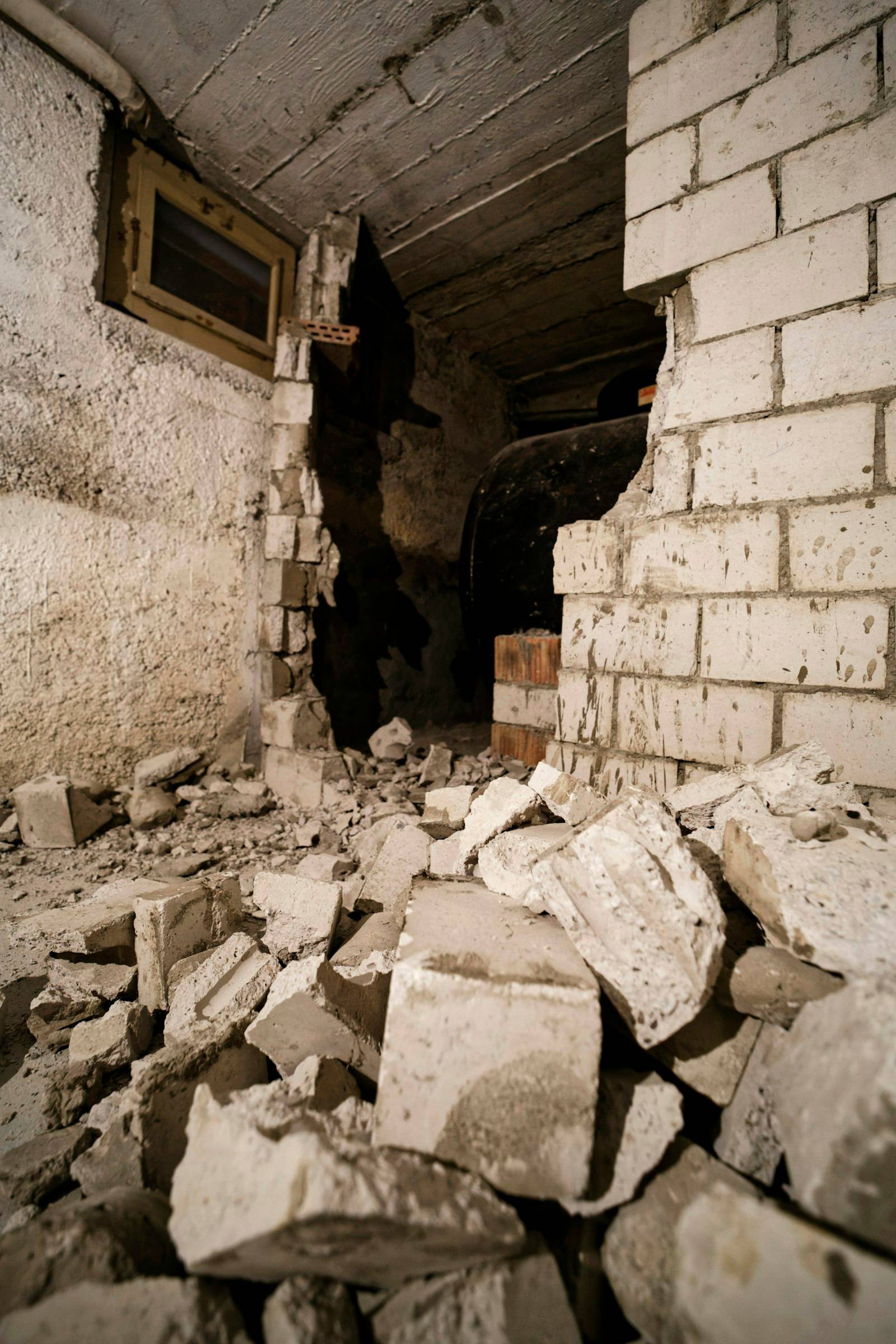
Concrete foundation repair, in the sense used here, means fixing damaged concrete: spalls, crumbling, honeycombing, scaling and rusting rebar. Shallow damage with no steel showing can usually be patched with repair mortar once the water causing it is dealt with. Damage that exposes corroding rebar, runs deep into a wall or footing, or keeps spreading needs an engineer’s assessment first.
Here because of settling or cracks?
“Concrete foundation repair” also gets used for houses that have moved, and for cracks. Those have their own guides:
- Cracks in the wall or slab: identify the crack with our guide to foundation cracks, then match it to a fix in foundation crack repair methods.
- Settling (sloping floors, sticking doors, gaps at trim): start with the signs of foundation problems, then see how piers, lifting and wall reinforcement work in foundation repair methods.
Is it the concrete, or did the foundation move?
If the concrete surface is breaking down but the house is level and doors work, the problem is the material, and this page covers it. If floors slope, doors stick or cracks are widening, the foundation has probably moved, and patching the concrete won’t help. Many houses have both, so check for movement before you price a patch.
| What you see | Most likely problem | Where to go |
|---|---|---|
| Flaking, pitting or chips popping off the surface | Material damage: scaling or spalling | This page: identify the damage |
| Rust stains, or rusty steel bars showing | Material damage: corroding reinforcement | This page: when it's structural |
| Rough pockets of exposed stone and holes | Material damage: honeycombing from the original pour | This page: when it's structural |
| Concrete that crumbles by hand, with web-like cracking across the wall | Material damage, possibly from the aggregate (pyrrhotite in parts of CT and MA) | This page: pyrrhotite, then a core test |
| White powder that wipes off | Efflorescence: a moisture signal, usually not damage in itself | This page, then fix the water source |
| A single crack, vertical, diagonal, horizontal or stair-step | Crack | Foundation cracks → crack repair |
| Sloping floors, sticking doors, a bowing wall | Foundation movement | Signs of foundation problems → repair methods |
How do you identify concrete damage on a foundation?
Most foundation concrete damage falls into one of seven types, and each points to a different cause. Look closely in daylight, and tap the damaged area lightly with a hammer: Angi’s spalling guide suggests listening “for any hollow sounds,” which mark concrete that has come loose below a surface that still looks intact.
| Defect | What it looks like | What it usually means |
|---|---|---|
| Scaling | A thin surface layer flaking or peeling, often over a wide area | Surface wear from freeze-thaw and de-icers. Shallower than spalling: Angi says spalling “occurs from deeper within the concrete than scaling does” (Angi) |
| Spalling | Chips or fragments breaking off, leaving a rough crater | Freeze-thaw, de-icers, rusting rebar, poor-quality concrete or shallow cover over the steel (Angi) |
| Delamination | Sounds hollow when tapped; may look sound | Concrete has separated below the surface. Tapping, as Angi suggests, shows how far the loose area extends |
| Honeycombing | Pockets of exposed stone and voids, usually present since the pour | Concrete “isn't properly consolidated” when placed (EVstudio). Depth decides how serious it is |
| Rust staining or exposed rebar | Orange-brown streaks, or bare bars in a spall | Reinforcing steel is corroding. The corrosion is what ICRI's repair guideline addresses (ICRI 310.1R) |
| Map or pattern cracking | A web of fine cracks across the face, sometimes with crumbling | Can be harmless drying shrinkage, which NRMCA calls a natural occurrence, or a sign of a reaction inside the concrete, such as alkali-silica reaction or pyrrhotite. Only lab testing of a core tells you which (CT DOH) |
| Efflorescence | White, yellow or brown powder that dissolves in water | Salts carried out by moisture. InterNACHI says it “alone does not pose a major problem” but “can be an indication of moisture intrusion” (InterNACHI) |
InterNACHI’s inspector guide gives two quick tests for telling efflorescence from mold: pinched between the fingers it turns to powder, and it dissolves in water; mold does neither. If the deposit is purple, pink or black, it isn’t efflorescence.
When is concrete foundation damage structural?
Concrete damage becomes a structural question when reinforcing steel is exposed or losing metal, when the damage goes deep into the wall or footing, or when it keeps spreading. Shallow damage with no steel showing is usually a maintenance repair. The table below is our synthesis of the sources named in each row, not a published standard; the engineer who sees your wall decides.
| Damage | Depth or extent | Rebar exposed? | Suggested action |
|---|---|---|---|
| Efflorescence | Surface deposit, no loss of concrete | No | Monitor Find and fix the water source (InterNACHI) |
| Scaling | Thin surface layer | No | Monitor Fix water and de-icer exposure; resurface or seal if wanted |
| Honeycombing, minor | Less than about 1 in deep | No | Monitor Patch with bonding agent and repair mortar (EVstudio) |
| Honeycombing, deep | Over 1–2 in, or through the section | Often | Get it inspected EVstudio says to engage a structural engineer first |
| Spalling, shallow | Up to about a third of the concrete's depth | No | Monitor Patch after fixing the cause. Angi says damage to about a third of the depth “won't usually require a rebar installation” (Angi) |
| Spalling, deep | More than about a third of the depth | Possibly | Get it inspected Angi: “you might need to install rebar as well” |
| Rust stains or exposed, corroding rebar | Any | Yes | Get it inspected ACI training slides: lost cross-section may “significantly reduce structural capacity”; repair damaged reinforcement “under the direction of a licensed engineer” (ACI) |
| Crumbling or map cracking across a whole wall | Widespread | Any | Get it inspected In CT and nearby MA, ask about pyrrhotite core testing (CT DOH) |
| Any of the above, plus a bulging or leaning wall, sagging beams or a rapidly widening crack | Any | Any | Urgent Get a professional assessment promptly |
The American Concrete Institute’s Guide to Concrete Repair (ACI 546R-14) sets the order of work: the methodology “typically includes a condition assessment of the structure,” and “assessment of the structure should determine the cause of the deterioration or deficiency and not focus only on the symptoms.” That is the case for paying an independent engineer before a contractor: someone who isn’t selling the repair tells you what the repair needs to be. Our guide on when you need a structural engineer for foundation repair covers what an evaluation includes.
Get help promptly
A wall that is bulging or leaning, a crack that is widening quickly, doors that suddenly won’t close, sagging beams or a gas smell all need professional help soon, not a patch. Concrete spalling in a load-bearing footing or a wall holding back soil is not a DIY project.
What causes concrete foundations to deteriorate?
Water drives almost all of it: freezing inside the concrete, carrying de-icing salts in, rusting the steel, or feeding a chemical reaction in the aggregate. Weak original concrete, from too much water in the mix or poor consolidation, lets the damage start sooner.
- Freeze-thaw and de-icers. Angi calls “deicing and freeze-thaw cycles in cold regions” the “most common causes of concrete spalling” (Angi). Water trapped in the concrete expands as it freezes and breaks the surface apart. Dalinghaus Construction, a foundation contractor, adds that rock salt “will react with your concrete,” causing pitting and scaling (Dalinghaus).
- Groundwater in warm climates. Where freezing is rare, the same contractor points to poor water management and built-up groundwater as the main reason foundations crumble.
- Poor original construction. Too much water in the mix weakens the concrete (Dalinghaus); poor consolidation leaves honeycombing (EVstudio); shallow cover over the rebar and poor curing let spalling start early (Angi).
- Chemical reactions in the aggregate. Angi lists alkali-silica reaction among spalling causes. In parts of New England, pyrrhotite (below) is the bigger concern.
- Load and impact. Angi also lists excessive weight and impact damage.
How rusting rebar breaks concrete from the inside
When steel reinforcement corrodes, the rust takes up more room than the steel did, so it pushes on the concrete around it until the cover cracks and spalls off. ICRI’s guideline 310.1R exists for exactly this: it covers preparing concrete “where corroded reinforcing steel has caused” cracking, spalling and delamination, including “exposing and undercutting reinforcing steel” (ICRI). The sequence matters for repair: once the bar is rusting, patching over it leaves the corrosion working under the new mortar, and the spall tends to come back. Rust stains on a wall are an early sign worth having looked at.
Crumbling foundations and pyrrhotite
In north-central Connecticut and nearby parts of Massachusetts, crumbling basement walls have been traced to pyrrhotite, an iron sulfide mineral in the stone used in the concrete. Connecticut’s Department of Housing says “pyrrhotite causes the slow deterioration of the concrete when exposed to oxygen and water,” and estimates “upwards of 35,000 homes in a radius of Stafford Springs, Connecticut” (CT DOH). The Massachusetts Geological Survey says reports began in Connecticut in 2015 and “quickly spread to portions of south central Massachusetts,” linked to a now-closed quarry, and that the compounds the mineral turns into “are expansive” (UMass).
If you live in the affected area
A patch will not fix pyrrhotite damage, because the reaction continues inside the wall. The answer starts with testing: Connecticut DOH says “a CORE test determines the presence, or absence, of pyrrhotite,” and its program page lists core testing reimbursed “at 50%, up to $2,000” and visual inspection “at 100% up to $400” for eligible homes built on or after January 1, 1983, and before December 31, 2015 (CT DOH). The page is undated and its newest linked release is from 2018, so confirm current terms with the program before you book. Massachusetts homeowners should check with their state for current help.
Concrete foundation repair options compared
The right repair depends on depth, whether the steel is involved and whether the cause has stopped. A patch fills a local defect; resurfacing restores a worn face; strengthening and replacement are engineer-led. None of them stops damage whose cause, usually water, is still active.
| Repair | What it fixes | What it doesn't fix | DIY? | Published cost |
|---|---|---|---|---|
| Patch with cementitious or polymer-modified repair mortar | Shallow spalls and minor honeycombing (EVstudio lists both mortar types for minor voids) | Corroding rebar left in place; ongoing water or chemical attack | Small, shallow, non-structural areas only | Quote; see costs |
| Full-depth spall repair around the rebar | Spalls where steel is exposed or corroding: concrete removed around the bar, steel cleaned, mortar placed (TxDOT) | Lost steel section, which needs an engineer's decision | No | Quote |
| Form-and-pour section repair | Larger or deeper areas where mortar is cast behind temporary forms; TxDOT leaves forms in place at least 72 hours | Widespread deterioration through the wall | No | Quote |
| Resurfacing or overlay | A worn, scaled or pitted surface | Anything below the surface, including corroding steel | Sometimes, on flat surfaces | $3–$9 per sq ft (Bob Vila, Dec 2023, dated) |
| Parging (a thin cementitious coat on a wall) | Appearance of a rough or patched wall face | Structural damage; it can hide problems from an inspector | Often | Quote |
| Crack injection or sealing | Individual cracks | Surface deterioration; settlement | Sometimes | $250–$800 crack filling (This Old House, Oct 2026). Methods: crack repair guide |
| Strengthening (carbon fiber wraps, steel plates, external post-tensioning) | Lost capacity in a section, as designed by an engineer (EVstudio) | The underlying cause of the deterioration | No | Quote |
| Replacing the wall or section | Concrete deteriorating throughout, where an engineer finds repair isn't practical | Nothing, if the cause is addressed, but it is the most disruptive option | No | Quote |
About this table
Bob Vila’s resurfacing range is for concrete resurfacing generally, sourced from Angi and HomeGuide in 2023, not for foundation walls specifically, and it is older than our other figures. We found no published, verifiable price for spall patching, parging or section replacement, so those rows say “quote” rather than show a number.
How a durable spall repair is done
A durable repair removes all loose and contaminated concrete, frees and cleans the steel, shapes the edges so the patch can’t pop out, and keeps the new mortar wet while it cures. The steps below come from the Texas Department of Transportation’s Concrete Repair Manual, which uses the International Concrete Repair Institute’s surface-profile terms. It was written for highway and bridge concrete, not houses, but it is one of the few openly published procedures, and it shows what separates a repair that lasts from a skim of patching compound.
- Find the cause and the full extent. ACI 546R-14 puts the condition assessment first. Sounding with a hammer finds delaminated concrete beyond the visible spall.
- Sawcut the perimeter. TxDOT has the edges cut so that repair material goes on “in depths no less than 1/2 inch,” removing feathered edges, and undercut “at an approximate angle of 30 degrees” where practical so the patch locks in.
- Free the rebar. “If more than 1/2 the perimeter” of a bar is exposed, or an exposed bar is significantly corroded, TxDOT removes concrete around the entire bar, with “¾-inch clearance or 1.5 times the largest sized aggregate in the repair material, whichever is greater.” Its rule of thumb: clearance is adequate when “you are able to wrap your fingers around the bar.”
- Clean the steel. ACI training slides say cleaning is “required to remove bond inhibiting materials,” though “all oxide does not need to be removed” (ACI). If the bar has lost noticeable metal, that’s the engineer’s call, not the patcher’s.
- Roughen and clean the surface. TxDOT’s target is a “minimum surface roughness profile of 1/8 inch or CSP (Concrete Surface Profile) 6 per ICRI,” with dust, oil and laitance removed.
- Dampen to saturated surface dry. Wet the old concrete so it won’t suck water out of the patch: saturated “to a depth of about 1/8 to 1/4 inches,” damp, with no standing water.
- Scrub coat, then place mortar. A thin layer of repair mortar is brushed hard into the surface, and the repair material goes on while that coat is still wet.
- Moist cure. TxDOT calls for moist curing exposed repair surfaces “for a minimum of 72 hours,” with wet mats, spray or ponding.
Red flags in a contractor’s plan: patching over rusty bars without exposing them all round; no sawcut edge, so the patch feathers out to nothing; no mention of the cause or the water source; no curing plan; or a thick parge coat over the whole wall before anyone has assessed what’s underneath. For vetting the contractor more broadly, see foundation repair red flags.
Know what repair your concrete needs? Compare vetted contractors who do concrete and foundation work near you.
Can you patch a concrete foundation yourself?
You can patch small, shallow, non-structural damage yourself: scaling, minor honeycombing, or a spall with no steel showing on a wall with no signs of movement. Exposed rebar, deep spalls, crumbling across a wall, or damage in a footing are jobs for a professional. Angi says “it’s best to leave concrete spalling repairs to the professionals, especially if you don’t know how or when the concrete was poured” (Angi).
A typical DIY approach, from Dalinghaus Construction’s crumbling-foundation guide: remove dust and loose concrete, wire-brush rust off any exposed rebar and pressure-wash; let it dry 24 hours; dampen it without soaking; brush on a cement paint or adhesive primer; apply patching compound, then a second layer after two hours; cover with a plastic tarp and mist it daily for two days.
That works for a shallow patch. Compared with TxDOT’s procedure, it leaves out three things that matter once steel is involved:
- No sawcut edge or minimum depth. TxDOT sawcuts the perimeter to remove feathered edges and wants at least 1/2 inch of repair material, undercut so the patch locks in.
- No clearance around the bar. Wire-brushing the face of a bar leaves rust and contaminated concrete behind it. TxDOT removes concrete all the way around a badly exposed or corroded bar.
- Shorter curing. Two days of misting, against TxDOT’s minimum 72 hours of moist curing.
EVstudio’s advice for minor honeycombing is similar in spirit: clean, apply a bonding agent, pack in cementitious or polymer-modified repair mortar, and keep it moist for 7 to 14 days (EVstudio). Follow the curing instructions on whichever product you buy, and treat hydraulic cement as a leak plug, not a general repair mortar; our crack repair guide explains why.
What does concrete foundation repair cost?
Published prices exist only for the smaller jobs: foundation crack filling runs $250 to $800 according to This Old House (updated October 8, 2026, Angi data), and concrete resurfacing $3 to $9 per square foot according to Bob Vila (December 2023). Deep spall, rebar and section repairs are quoted per job.
| Work | Published cost | Source and date |
|---|---|---|
| Foundation crack filling | $250–$800 | This Old House, Oct 8, 2026 (Angi data) |
| Concrete resurfacing | $3–$9 per sq ft; average about $6 | Bob Vila, Dec 21, 2023 (Angi, HomeGuide). Dated; general concrete, not foundation-specific |
| Basement floor resurfacing | $3–$5 per sq ft | Bob Vila, Dec 2023. Dated |
| Repairing more extensive concrete damage | $300–$3,500, depending on scope | Bob Vila, Dec 2023. Dated |
| Spall patching, rebar repair, parging, section replacement | No verifiable published price | Get written quotes |
| Pyrrhotite core test (Connecticut) | Reimbursed at 50%, up to $2,000 | CT DOH, undated page; confirm current terms |
These are national figures, not a quote for your house. Get at least two written quotes that name the repair method, the depth of removal, how rebar will be treated and the curing plan, so you can compare like with like. If your foundation has also settled or a wall is bowing, the repairs and prices are of a different order; see our foundation repair cost guide and, for a planning range, the foundation repair cost calculator.
How to keep concrete damage from coming back
Keep water away from the concrete, and keep salt off it: most repairs fail because the water that caused the damage is still getting in.
- Fix drainage first. Gutters, downspout extensions and soil that slopes away from the wall reduce the water reaching the foundation. Treat efflorescence as a sign that water is still getting through (InterNACHI).
- Keep de-icers off foundation concrete. Angi and Dalinghaus both name de-icing salt as a cause of scaling and spalling. Don’t pile salted snow against foundation walls.
- Fix leaks. Plumbing or window-well leaks that keep one area wet will undo a patch in that area. See plumbing leaks and foundations.
- Seal after repair, not instead of it. Angi says sealing will stop spalling “in most cases” but may only delay it (Angi). A sealer won’t stop steel that is already corroding.
- For new pours or replacement walls, the American Cement Association (formerly the Portland Cement Association) notes that “using quality materials, a low water-to-cement ratio, and suitable aggregates will all decrease concrete permeability and minimize the impact of aggressive materials” (Cement & Concrete FAQ).
- Recheck once a year. Photograph repaired areas and look for new rust stains, hollow-sounding patches and fresh efflorescence.
Concrete foundation repair questions
What is concrete spalling on a foundation?
Spalling is when pieces of the concrete surface chip, flake or pop off, leaving a rough crater. Angi names de-icing and freeze-thaw cycles as the most common causes in cold regions, and also lists rusting reinforcing steel, poor-quality concrete or installation, chemical exposure and alkali-silica reaction. Shallow spalls with no steel showing can usually be patched. Spalls that expose rusting rebar need a proper repair, often with an engineer's input.
Is spalling concrete a structural problem?
Usually not when it is shallow and no reinforcement shows. It becomes a structural question when rebar is exposed and corroding, when the damage goes deep into a wall or footing, or when it keeps spreading. American Concrete Institute training material says lost bar cross-section may significantly reduce structural capacity and that damaged reinforcement should be repaired under the direction of a licensed engineer.
What is the difference between scaling and spalling?
Scaling is a thin surface layer flaking or peeling away, often after freeze-thaw cycles and de-icing salts. Spalling starts deeper in the concrete and breaks off larger pieces, sometimes because steel underneath is rusting. Angi makes the same distinction, saying spalling occurs from deeper within the concrete than scaling does. Scaling is mostly cosmetic; spalling deserves a closer look at what is underneath.
Can you patch a crumbling concrete foundation?
You can patch isolated, shallow damage, but a patch does not stop concrete that is breaking down from within. In north-central Connecticut and nearby parts of Massachusetts, crumbling has been linked to pyrrhotite in the aggregate, which Connecticut's Department of Housing says causes slow deterioration when exposed to oxygen and water. A core test, not a patch, tells you whether that is the cause.
What is honeycombing in a concrete foundation?
Honeycombing is a patch of voids and exposed stone left where concrete was not properly consolidated when it was poured. EVstudio treats voids less than about 1 inch deep with no exposed rebar as minor and repairable with a bonding agent and repair mortar. Voids deeper than 1 to 2 inches, or voids that expose reinforcement, call for a structural engineer before any repair.
How should exposed rebar in a foundation be repaired?
A durable repair removes concrete all the way around a badly exposed or corroded bar. TxDOT's procedure calls for at least 3/4 inch of clearance, enough to wrap your fingers around the bar. The steel is cleaned of rust, the surface roughened and dampened, a scrub coat brushed in, then repair mortar placed and moist-cured for at least 72 hours. Patching over a rusty bar leaves the corrosion working.
Will sealing a concrete foundation stop spalling?
It can help, but it does not replace fixing the cause. Angi says sealing will stop spalling in most cases but may only delay it. Sealing keeps out some water and salts, so it works best after repairs are done and after the water source, such as poor drainage, de-icer runoff or a leak, has been dealt with. It will not stop steel that is already corroding inside the wall.
How much does concrete foundation repair cost?
For the concrete itself, This Old House puts foundation crack filling at $250 to $800 (October 2026, Angi data). Bob Vila's older figures, from December 2023, put concrete resurfacing at $3 to $9 per square foot. Deep spall repairs, rebar repairs and section replacement are priced per job, so get written quotes. Settlement repairs such as piers are a different scale of cost entirely.
Sources
- ACI Committee 546 — ACI 546R-14, Guide to Concrete Repair (preview; first printing September 2014)
- ICRI — 310.1R-2008 Guideline for Surface Preparation for the Repair of Deteriorated Concrete Resulting from Reinforcing Steel Corrosion (store listing)
- TxDOT — Concrete Repair Manual, Ch. 3 §2 Intermediate Spall Repair: Repair Procedure (undated web manual, checked October 18, 2026)
- American Concrete Institute — Field Guide to Concrete Repair Application Procedures, web session slides (Peter Emmons; slides dated January 15, 2013)
- NRMCA — CIP 7: Cracks in Residential Basement Walls (1979, 2000, 2014)
- Angi — Concrete Spalling (updated July 31, 2026)
- EVstudio (Mark Stines) — Honeycombing in Concrete Foundations (May 28, 2025)
- InterNACHI (Nick Gromicko and Ben Gromicko) — Efflorescence for Inspectors (undated)
- Dalinghaus Construction — How To Repair Your Concrete Foundation That's Crumbling (December 3, 2022; updated March 28, 2024)
- Connecticut Department of Housing — Crumbling Foundations (undated program page; latest linked release May 2, 2018)
- Massachusetts Geological Survey (UMass Amherst) — Crumbling Foundations and Pyrrhotite (undated)
- American Cement Association (formerly Portland Cement Association) — Cement & Concrete FAQ (modified July 21, 2026)
- This Old House — Foundation Repair Cost (updated October 8, 2026; Angi data)
- Bob Vila — Concrete Resurfacing Cost (updated December 21, 2023; Angi and HomeGuide data)