Warning signs
Foundation Cracks: How to Read Type, Width and Movement (and When to Worry)
Most foundation cracks are shrinkage, not failure. Where a crack is, what shape it takes, whether one side has shifted and whether it is still moving tell you far more than width alone.
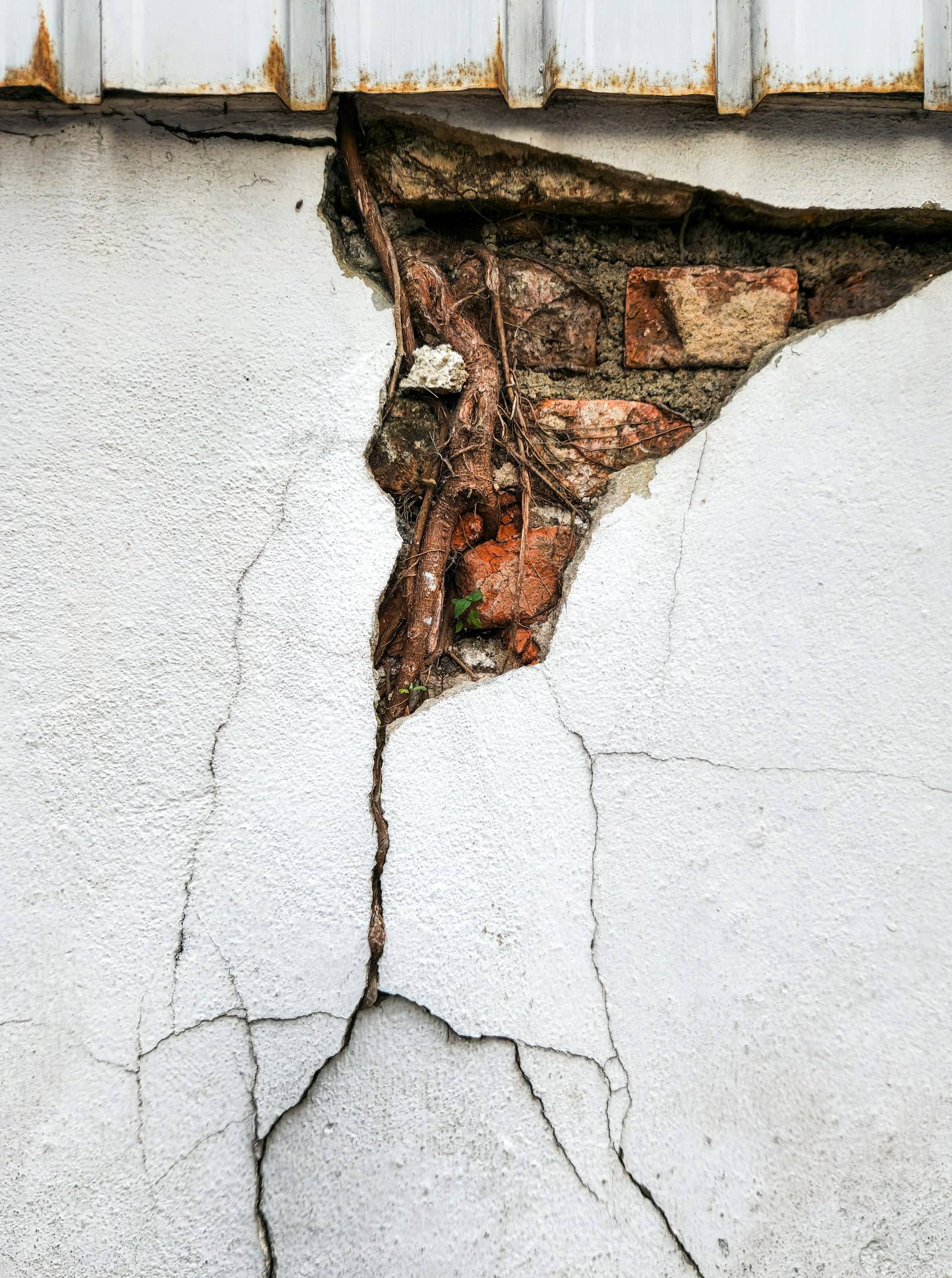
Most foundation cracks are harmless shrinkage: concrete cracks as it dries, and the American Concrete Institute says that cracking “can never be eliminated in most structures.” Worry when a crack runs horizontally in a basement wall, when one side has shifted relative to the other, when the wall bows, or when the crack keeps widening.
Width matters less than most online advice suggests. The NAHB puts it plainly: “There is no absolute universal standard for evaluating cracks,” and “the vast majority of cracks are ‘cosmetic,’ not ‘structural’.” Use the identifier below to narrow down what you’re looking at, then measure and watch it. Once you know what you have, the foundation crack repair guide matches it to a repair, and the crack repair cost guide prices it.
What does my foundation crack pattern mean?
A crack’s pattern, combined with the material it’s in, usually points to one or two likely causes. The diagrams sketch six common patterns; the table after them maps the patterns homeowners see most often to what the cited sources say they usually mean. The badge is a starting point, not a diagnosis: a crack that is widening moves up a tier, whatever its pattern.
Foundation crack patterns at a glance
Hairline vertical crack
Poured concrete wall
MonitorUsually shrinkage as the concrete cured. Seal it if it leaks; note its width and date.
Vertical crack, wider at the top
Any wall
Get it inspectedUsually settlement: settlement cracks tend to be wider at the top, where part of the foundation has dropped more than the rest.
Diagonal crack from a window corner
Poured wall, at a window or door opening
MonitorOften shrinkage concentrated at the corner. It moves up a tier if it widens, tapers or runs on across the wall.
Stair-step crack
Block or brick wall
Get it inspectedFollows the mortar joints. Often soil pressure on a block wall, or settlement. If the wall bows or leans, treat it as urgent.
Horizontal crack
Poured basement wall
Get it inspectedOften lateral soil or water pressure on the wall, and a structural indicator. If the wall bows or leans, treat it as urgent.
Map or shrinkage cracks in a slab
Garage or interior slab
MonitorShallow random cracks from drying shrinkage. Look closer only if one side is higher than the other.
Schematic diagrams, not to scale. The tier matches the identifier table below and is only a starting point: any crack that is growing, offset or letting in water moves up a tier.
| Crack pattern | Where you see it | Most likely cause | Suggested action |
|---|---|---|---|
| Hairline or random map cracking | Poured walls, slabs | Drying shrinkage, which NRMCA calls a natural occurrence | Monitor Seal only if it leaks |
| Vertical, even width | Poured concrete basement wall | Shrinkage; Pillar To Post says these are usually under 1/8 in wide | Monitor Repair if it leaks (NAHB, per NRMCA) |
| Vertical or diagonal, wider at the top | Any wall | Settlement; InspectAPedia says settlement cracks are usually wider at the top | Get it inspected |
| Diagonal from a window, door or opening corner | Poured wall | Re-entrant corner cracking from shrinkage (NRMCA) | Monitor |
| Diagonal, tapered, across the wall | Poured wall, slab | Settlement, which NRMCA attributes to non-uniform footing support or occasionally expansive soil | Get it inspected |
| Horizontal | Poured basement wall | Lateral soil or water pressure (This Old House); NAHB lists it as a structural indicator | Get it inspected |
| Stair-step along mortar joints | Concrete block (CMU) wall, brick | Soil pressure in block walls (This Old House), or settlement | Get it inspected |
| Horizontal or stair-step with the wall bowing or leaning | Basement wall | Wall yielding to soil pressure; NAHB lists bowing or leaning as a structural indicator | Urgent |
| Offset or shear: one face sits proud of the other | Any wall or slab | Differential movement; Pillar To Post calls shear cracks a significant structural concern | Get it inspected Promptly |
| Random cracks, no distress elsewhere in the house | Slab-on-grade | Shrinkage; FPA advises waiting until cracking appears dormant, then repairing as needed (FPA-SC-03-1) | Monitor |
| Surface cracks before tendons are stressed | Post-tensioned slab (new build) | Curing shrinkage; these "typically close after stressing" (FPA-SC-03-1) | Monitor |
| Slab crack with a vertical lip | Slab-on-grade | Vertical displacement, which NAHB lists as a structural indicator | Get it inspected |
| Straight line where two pours met | Poured wall | A pour line or cold joint, often mistaken for a crack (NRMCA) | Monitor Seal if it leaks |
| Full-height vertical crack, even width | Brick veneer | Thermal expansion and contraction where an expansion joint is needed (FPA-SC-03-1) | Monitor |
| Short horizontal crack at a window lintel | Brick veneer | Corroding steel lintel lifting the brick (FPA-SC-03-1), not the foundation | Get it inspected By a mason |
| Any crack that keeps widening | Anywhere | Active movement; NRMCA advises professional evaluation | Get it inspected Urgent if fast |
How to read the badges
Monitor means mark it, measure it and recheck it (see the monitoring method below). Get it inspected means a structural engineer or experienced foundation professional should look at it. Urgent means arrange that inspection now and keep people clear of a wall that is visibly moving. Local soil, the building code and the person on site decide the final call.
Each pattern has its own deeper guide: horizontal foundation cracks, vertical foundation cracks, stair-step foundation cracks and hairline foundation cracks. A bowing wall is covered in bowing foundation walls.
How wide is too wide for a foundation crack?
No single width separates a safe crack from a dangerous one, and the published numbers disagree because they were written for different jobs. Among the top-ranking guides, the line between minor and serious ranges from 1/16 inch (Groundworks’ upper limit for a hairline crack) and 1/10 inch (Groundworks’ “serious” sign) through 1/8 inch (Ask the Builder, Bob Vila) and 1/4 inch (This Old House, Bob Vila) to 1/2 inch (Ask the Builder, Bob Vila). None of them cites a standard. The scale below shows what those widths look like; the standards follow.
- 1/64 inAbout 0.4 mm. Hairline.
- 1/32 inAbout 0.8 mm.
- 1/16 inAbout 1.6 mm.
- 1/8 inAbout 3.2 mm.
- 1/4 inAbout 6.4 mm.
- Dime edge1.35 mm (about 1/19 in), per the U.S. Mint. A crack a dime's edge slides into is wider than 1/32 in.
Screen sizes vary, so these bars are only approximately actual size. Confirm with a printed ruler or a plastic crack-width gauge before you record a reading.
How to measure a crack’s width
Measure at the widest point, then mark that spot so every later reading is taken in the same place. Four simple tools cover most cracks:
- A plastic crack-width gauge or a ruler. A gauge card has printed lines of known width; hold it against the crack and find the line that matches. For wider cracks, a ruler marked in 1/16 or 1/32 inch works. For a rough estimate, FPA’s homebuyers’ guide suggests “coins, credit cards, thumbnail, tape measure or other available means.”
- Pencil end-marks with the date. A short tick across each end of the crack, with the date written beside it, shows whether the crack has grown longer since the last check.
- Dated photos with a scale in frame. Put a ruler or the gauge card next to the crack so the photo records the width, not just the shape, and note the date on each shot.
- The dime test, for a rough check. A U.S. dime is 1.35 mm thick, according to the U.S. Mint, which is about 0.053 inch (our conversion: 1.35 ÷ 25.4). If a dime’s edge slides into the crack, the crack is at least that wide: more than 1/32 inch, though not necessarily more than 1/16 inch. Use a gauge or ruler for the reading you record.
To tell whether the crack is still moving, keep taking readings the same way over time, as set out in the monitoring method below.
BRE Digest 251, converted to inches
The UK Building Research Establishment classifies visible damage by crack width into categories 0 to 5 (Designing Buildings Wiki). BRE groups categories 0 to 2 as aesthetic, 3 and 4 as affecting serviceability, and 5 as a stability issue “likely to require structural intervention.” The inch figures are our conversion (mm ÷ 25.4).
| Category | Crack width (BRE) | Approx. inches (our conversion) | BRE grouping |
|---|---|---|---|
| 0 | Less than 0.1 mm | Under 0.004 in | Aesthetic |
| 1 | Up to 1 mm | Up to 0.04 in (about 1/25 in) | Aesthetic |
| 2 | Up to 5 mm | Up to 0.20 in (about 3/16 in) | Aesthetic |
| 3 | 5 to 15 mm | 0.20 to 0.59 in (about 3/16 to 5/8 in) | Serviceability |
| 4 | 15 to 25 mm | 0.59 to 0.98 in (about 5/8 to 1 in) | Serviceability |
| 5 | Greater than 25 mm | Over 0.98 in (about 1 in) | Stability |
The US numbers on one scale
The table below lines up every threshold from the cited sources from narrowest to widest, with millimetre equivalents (inches × 25.4) so you can compare them with BRE.
| Width | Approx. mm | What the source says | What the number is for |
|---|---|---|---|
| 0.016 in | 0.4 mm | A "reasonable" crack width for reinforced concrete under service loads in dry air, per ACI 224R-01; with time widths can double (ASCC) | A design guide for engineers, not a repair trigger |
| 1/64 in | 0.4 mm | FPA's example of a "hairline" brick crack (FPA-SC-06-0) | Description for homebuyers |
| 1/16 in | 1.6 mm | NAHB performance-guideline threshold for drywall (NAHB 2018) | Builder performance threshold for finishes |
| 1/8 in | 3.2 mm | A typical basement warranty repairs cracks wider than 1/8 in, cracks that leak, or cracks with measurable vertical displacement (NRMCA). Also NAHB's stucco threshold and the top of R.W. Day's "negligible to slight" band | Warranty trigger and engineering severity scale |
| 3/16 in | 4.8 mm | NAHB threshold for a concrete floor slab; start of R.W. Day's "moderate" band (3/16 to 9/16 in) | Builder performance threshold; severity scale |
| 1/4 in | 6.4 mm | NAHB threshold for concrete basement walls, concrete footings, and masonry walls or mortar joints | Builder performance threshold |
| 9/16 in | 14.3 mm | Start of R.W. Day's "severe" band (9/16 to 1 in); close to BRE's 15 mm category 3/4 boundary | Engineering severity scale |
| Over 1 in | Over 25.4 mm | R.W. Day's "very severe"; BRE category 5 | Engineering severity scale |
About these figures
NAHB thresholds and the R.W. Day (2011) bands are as quoted in NAHB’s January 2018 presentation; the latest edition of NAHB’s Residential Construction Performance Guidelines may differ. The ACI figure applies to reinforced concrete in dry air; values for other exposures are not shown here.
Why the numbers disagree, and why width is a weak signal
They disagree because each answers a different question. NRMCA’s 1/8 inch is when a typical builder warranty pays for a basement crack repair. NAHB’s 1/4 inch for basement walls is the builder performance threshold for that material, so it changes by material: 3/16 inch for a slab, 1/16 inch for drywall. BRE’s categories describe how much repair visible damage needs. ACI’s 0.016 inch is a design target for reinforced concrete. Contractor and publisher rules of thumb pick one of these lines, or none.
Width on its own is a weak signal. NAHB’s structural indicators are vertical displacement and horizontal basement wall cracks with bowing or leaning, not a width. Pillar To Post notes that its 1/4-inch rule of thumb for settlement cracks “does not apply” to shear cracks. And the ASCE Texas Section guidelines say “the majority of cracks do not compromise structural integrity,” and that the cracks’ physical characteristics should be weighed when judging whether they do. A 1/16-inch crack that has doubled in three months tells you more than a 1/4-inch crack that hasn’t changed in ten years.
The deeper comparison lives in when is a foundation crack serious?
How do poured walls, block walls and slabs crack differently?
The same soil pressure leaves a different mark depending on what the foundation is made of, so identify the material before you read the crack. This Old House gives an example: horizontal cracks from inward soil pressure are “often accompanied by diagonal cracks in poured foundations or stair-step cracks in block foundations.”
| Foundation type | Usually harmless | Look closer | Key threshold cited |
|---|---|---|---|
| Poured concrete wall | Vertical shrinkage cracks, re-entrant cracks at window corners, pour lines | Horizontal cracks, offset faces, inward bow, cracks wider at the top | NAHB: over 1/4 in; NRMCA warranty: over 1/8 in |
| Concrete block (CMU) wall | Small cracks in individual mortar joints | Stair-step cracks, horizontal joint cracks, blocks pushed out of line | NAHB masonry or mortar joint: over 1/4 in |
| Slab-on-grade | Random shrinkage cracks with no distress elsewhere | Cracks with a vertical lip, cracks that line up with sticking doors or sloping floors | NAHB slab: over 3/16 in |
| Brick veneer over a slab | Even, full-height vertical cracks at missing expansion joints | Stair-step cracks through several bricks, cracks wider at one end, expansion joints that taper | Record length, width and shape (FPA) |
Poured concrete walls
Poured walls almost always show a few vertical or diagonal shrinkage cracks. NRMCA notes that “some cracking is normal in concrete basement walls,” that diagonal cracks from window and door corners come from shrinkage, and that pour lines (cold joints) are “often perceived as cracks.” It also notes that structural cracks can form during backfilling “when heavy equipment gets too close to the walls.” NRMCA adds that NAHB requires repair or corrective action when basement wall cracks cause leaks, so a leaking shrinkage crack still needs sealing even if it’s structurally minor.
Concrete block (CMU) walls
Block walls crack along their mortar joints, which is why lateral pressure produces stair-step or horizontal joint cracks rather than a single straight line. InspectAPedia, citing the National Concrete Masonry Association, notes that drying shrinkage, temperature and carbonation alone can produce large cracks in masonry, with differential settlement the next leading cause. That makes a block wall’s crack pattern less telling on its own; look for blocks that have shifted out of line or a wall that is no longer plumb.
Slab-on-grade and post-tensioned slabs
Slab cracks are expected: ACI says “it is normal to expect some amount of cracking and curling on every project.” On new post-tensioned slabs, surface cracks that form before the tendons are stressed come from curing shrinkage and “typically close after stressing. No repair is usually required” (FPA-SC-03-1). For miscellaneous slab cracking with no distress in the house above, the same FPA paper’s advice is to “wait until cracking appears dormant, and then repair as needed.” On the perimeter grade beam, FPA’s homebuyers’ guide says hairline cracks “are generally acceptable but may indicate that there has been some foundation movement.”
Brick veneer over a slab
Cracks in brick veneer are often read as foundation failure when they aren’t. FPA-SC-03-1 attributes full-height vertical cracks of uniform width to thermal movement where an expansion joint is missing, and short horizontal cracks at window lintels to rusting lintels lifting the brick. FPA’s homebuyers’ guide suggests asking: does the crack pass through more than one brick, is it larger at the top than the bottom, and does a nearby expansion joint vary in thickness from top to bottom? A tapering expansion joint “is a possible indication of excessive foundation movement.”
Is the crack still moving? How to monitor it over time
The only way to know whether a crack is still moving is to measure it the same way, at the same spot, over time. The Foundation Performance Association recommends monitoring a foundation “for a minimum of one year to assess whether the movement is cyclical or non-cyclical,” because many cracks open in dry months and close in wet ones without the foundation getting worse.
- Mark the ends. Pencil a short tick across each end of the crack and write the date beside it. If the crack grows past a tick, you’ll see it.
- Measure the width at a fixed point. Draw a small circle at the widest spot and always measure there. A plastic crack-width card works well; FPA’s homebuyers’ guide also lists coins, credit cards, a thumbnail or a tape measure for rough checks.
- Photograph it the same way each time. Stand on a marked spot, put a ruler in frame, and take one wide shot and one close-up. FPA recommends “a series of photographs.”
- Add a tape-and-pencil gauge for better data. GSA’s procedure puts a piece of tape on each side of the crack, with “one short line on each piece of tape at a convenient distance apart (2 inches),” then records the distance between the marks “at weekly intervals.” If that 2 inches grows, so has the crack.
- Or fix a tell-tale. GSA describes epoxying a glass slide across the crack: “If the glass breaks, it is an indication that the walls are still moving and that the crack is widening.” A two-plate crack monitor, such as the Avongard monitor GSA describes, is fixed across the crack with screws or adhesive and reads movement against a printed scale.
- Keep going for a year. Weekly readings at first (GSA), then keep recording through every season to meet FPA’s one-year minimum. Note recent rain or drought with each reading.
| Date | Crack ID and location | Width at marked point | Past end ticks? | Gauge reading | Photo no. | Weather in past week | Notes (water, offset, doors) |
|---|---|---|---|---|---|---|---|
| A: north basement wall, 3 ft from corner | Yes / No | ||||||
| Yes / No |
Don’t fill or paint over a crack you’re monitoring; you’ll erase the evidence. If water is coming in, deal with the water first and keep a photo record of the crack before any sealing. Deciding between sealing now and watching longer is covered in repair vs monitor a foundation crack.
Is my foundation crack serious? Red flags that matter more than width
Some cracks need a professional regardless of how narrow they are. Get an inspection promptly if you see any of these:
- A horizontal crack in a basement wall, especially with the wall bowing or leaning inward. NAHB lists both as structural indicators. A bowing wall is Urgent: keep people clear of it.
- One side of the crack sitting higher or further out than the other. NAHB counts vertical displacement as a structural indicator, and NRMCA notes that a typical warranty covers it at any width.
- A crack that is getting wider. NRMCA: “Seek professional advice to evaluate and repair active cracks that are widening with time.”
- Water or soil coming through. According to NRMCA, NAHB requires repair or corrective action when basement wall cracks leak.
- A crack that is wider at one end. InspectAPedia says settlement cracks are usually wider at the top, and FPA’s homebuyer guide tells you to check for this taper.
- Cracks that show up alongside sticking doors, sloping floors or gaps at window frames. Several signs together point to movement; see signs of foundation problems.
Safety first
A rapidly widening crack, a wall that is visibly bulging or leaning, doors that suddenly won’t close, or a smell of gas after new movement all need help promptly. Stay out of an area that looks unstable, and don’t try to brace or jack a wall yourself.
Seeing one of these red flags? Have the whole foundation looked at, not just the crack.
What causes foundation cracks?
Most cracks come from the concrete itself; fewer come from the ground moving under or against it.
- Drying shrinkage. Concrete shrinks as it cures. ACI says this cracking “can never be eliminated in most structures.”
- Thermal movement. NAHB’s example: a 100-foot outside concrete wall expands and contracts about 0.50 inch with a 75°F temperature change.
- Settlement. NRMCA attributes settlement cracks to “non-uniform support of footings.”
- Expansive soil. Clay that swells when wet and shrinks when dry can heave or drop part of a foundation; NRMCA lists it as an occasional cause of settlement cracks. See expansive clay soil and foundations.
- Lateral soil and water pressure. Pushes basement walls inward, producing horizontal or stair-step cracks (This Old House).
- Backfill damage. Heavy equipment too close to new walls during backfilling (NRMCA).
- Plumbing leaks and drainage. Water from a leak or poor drainage can change how the soil supports a foundation; see plumbing leaks and foundation damage.
- Corroding steel. Rusting window lintels can crack brick above openings (FPA).
Monitor, seal or call an engineer: matching the tier to an action
What you do next depends on which tier your crack landed in, and repair choices and prices are covered in their own guides.
- Monitor Mark, measure and log the crack for at least a year. Seal it only if it leaks or lets in soil. Use repair vs monitor a foundation crack to decide when to stop watching.
- Seal or repair. A dry, stable crack and a leaking crack call for different materials, and a crack caused by ongoing movement won’t stay sealed until the movement is fixed. Foundation crack repair explains the methods, including epoxy injection and polyurethane injection.
- Get it inspected An independent structural engineer can tell you whether the crack is a symptom of movement before anyone sells you a repair. See do you need a structural engineer?
- Budget. Prices for sealing, injection and wall reinforcement are in the foundation crack repair cost guide. Whether insurance pays is covered in does homeowners insurance cover foundation repair?
Know what kind of crack you have? Compare the repair options before you get quotes.
Foundation crack questions
How can you tell if a foundation crack is structural?
Look at direction, displacement and growth before width. NAHB's 2018 guidance lists cracks with vertical displacement and horizontal basement wall cracks, especially with bowing or leaning, as structural indicators, and NRMCA says cracks that widen over time need professional evaluation. Thin vertical cracks and diagonal cracks running from window corners are usually shrinkage. Check for related signs such as sticking doors or sloping floors before deciding.
Are hairline cracks in a foundation normal?
Usually, yes. ACI 224R-01 says cracking from drying shrinkage can never be eliminated in most structures, and NRMCA says some cracking is normal in concrete basement walls. BRE Digest 251 puts cracks under 0.1 mm, about 0.004 inch, in its lowest category. Seal a hairline crack if it leaks or lets in soil gas, and mark its ends so you will notice if it grows.
What width of foundation crack should I worry about?
There is no universal standard, which is why online advice ranges from 1/16 to 1/2 inch. NAHB's performance guidelines flag basement wall cracks over 1/4 inch and slab cracks over 3/16 inch. A typical basement warranty, per NRMCA, covers cracks over 1/8 inch, cracks that leak, or cracks with vertical offset. BRE treats cracks wider than 5 mm, about 3/16 inch, as more than cosmetic.
Is a vertical or horizontal foundation crack worse?
In a basement wall, a horizontal crack is generally the bigger concern, because it often means soil or water pressure is pushing the wall inward, especially if the wall bows. Vertical cracks in poured walls are commonly shrinkage cracks with a fairly even width. A vertical crack that is wider at the top than the bottom points to settlement and should be checked by a professional.
What does a stair-step crack mean?
Stair-step cracks follow the mortar joints in concrete block or brick. This Old House notes that horizontal cracks from soil pressure are often accompanied by stair-step cracks in block walls, and that stair-step cracks on their own can mean uneven footing settlement. In brick veneer, a stair-step crack that is wider at one end can point to settlement. Measure the widest point, check whether blocks or bricks have shifted, and have a wide or growing stair-step crack inspected.
How do I monitor a foundation crack?
Pencil a tick and the date at each end of the crack, measure its width at one marked spot with a crack-width card, and photograph it from the same position with a ruler in frame. A two-plate crack monitor gives cleaner readings. GSA's procedure takes readings weekly, and the Foundation Performance Association recommends at least a year of monitoring so seasonal soil movement is not mistaken for failure.
Should I seal a foundation crack right away?
Seal promptly if water, soil or soil gas is coming through. Otherwise it often pays to measure first, because filling a crack hides any further growth and a repair will not hold if the movement continues. The Foundation Performance Association's guidance for slab cracks with no distress elsewhere in the house is to wait until the cracking appears dormant and then repair as needed.
Sources
- NRMCA — CIP 7, Cracks in Residential Basement Walls (2014 edition)
- NAHB — Misconceptions About the Common Crack, Walt Keaveny, PE (Jan 8, 2018)
- Designing Buildings Wiki — Cracking and building movement (BRE Digest 251 categories, Oct 28, 2022)
- BRE — Assessing cracks in houses (Apr 15, 2014)
- ACI — 224R-01 Control of Cracking in Concrete Structures, Chapter 3
- ASCC — Position Statement #33, Cracks in Structural Concrete
- ACI — Technical FAQ #906, cracking and curling in floors
- Foundation Performance Association — FPA-SC-03-1, Distress Phenomena Often Mistakenly Attributed to Foundation Movement (May 1, 2004)
- Foundation Performance Association — FPA-SC-06-0, Homebuyers' Guide for Foundation Evaluation (Oct 10, 2005)
- Foundation Performance Association — FPA-SC-12-0, Guidelines for Evaluating Foundation Performance by Monitoring (Jan 9, 2006)
- ASCE Texas Section — Guidelines for the Evaluation and Repair of Residential Foundations, Version 3 (2022)
- U.S. GSA — Monitoring and Evaluating Cracks in Masonry (technical procedure)
- Pillar To Post — Foundation Cracks (V1.0)
- This Old House — What to Know About Basement Foundation Wall Cracks (updated Apr 14, 2026)
- InspectAPedia — Foundation Crack Types
- Groundworks — Foundation Cracks: When to Take Action (updated Aug 11, 2026)
- Bob Vila — Foundation Cracks (updated Sep 22, 2025)
- Ask the Builder — Foundation Cracks: Signs, Causes, and Types (Feb 2021)
- United States Mint — Dime specifications (checked Oct 18, 2026)